This week has been full of lessons on how to help establish voice and how to listen to what others have to say. Several moments in particular stood out for me.
We were lucky enough to have the opportunity to interview Dana Lupton, the Executive/Artistic Director of Moving in the Spirit here in Atlanta. While we were there to interview her, she made sure to learn about each of us individually. In the safe space she created we were able to not only learn about her but find out new things about each other. We did an exercise where we put in writing our name, three adjectives that described us, four relationships we were in, three things we love, two things we hate, three things we need, two things we'd fight to the death for, a secret super power we possess, and finished the sentence I am a resident of....blank. In sharing our answers with each other, we established connections or differences we had. An important moment for me was when I described myself as an introvert and my three MAP mates were surprised by that. I was glad I got to share that with them because that's an important dynamic to understand when you're living with people, who wants to be surrounded with people all the time or if they like to do some things alone. This exercise was a good lesson on voice because it added a written component to self-identification. We've introduced ourselves a million times since arriving but it was the first time we did it in writing. Furthermore, we got to hear each other's voices and learn about what they wanted to talk about/what was important to everybody.
Another moment this week was an exercise conducted by Rachel May during the summer program of Playmaking for Girls. The purpose of the exercise was to create stage presence. The girls entered the space with purpose, took in the room by making eye contact with everyone in it, stomped their feet one at a time, stated their name for everyone to hear, and exited the space with purpose. The girls reacted in many different ways, some were embarrassed, frustrated, annoyed, silly but the teachers talked them all through it, making some of them do it multiple times until they understood the seriousness of the exercise. When we got to see the show yesterday afternoon, each girl came up and stated her name and several important relationships in her life. They were all so confident and powerful that it was a "magic moment" as Heidi likes to say.
The final moment I'd like to talk about was more an overall experience than a certain moment. I felt that everyone's voices mattered in the collaboration between Julie Rothschild, Andrea Trombetta, Celeste and the four of us. Originally, I was under the impression that we were going to observe the three of them merge their solos into one performance so it was great to get to participate in the process and have the chance to give input. I appreciated it when Celeste tried out a new ending to her solo, based on a suggestion from Julie, but, when she ultimately decided that it did not fit the intended message/purpose of the piece, her decision was respected and we worked to incorporate ourselves into her ending to giver her message even more power. It was a great example of collaboration without an imbalance in power.
All in all it was a great week and I felt like I got to connect with a lot of people!
Sunday, June 14, 2015

Sunday, June 7, 2015
Two Sides of the Same Coin by Ebony Chuukwu


**Saw this and bought it from an artist off the street. I think they tell two completely different stories when faced on opposite angles.
1. All of the Feels by Ebony Chuukwu
WOW this week has been interesting. Firstly, coming from Grinnell IA to Atlanta is truly a change within itself. It's so nice to see various groups of races, styles, shapes, and sizes in this eclectic city! That put me at ease as soon as we drove to our first meeting at 7 Stages in Little Five Points. This part of Atlanta was so colorful that it literally put a smile on my face just to drive through the neighborhood. When meeting some of the leaders of the theater organizations that we would be working with, it was truly inspiring that I was sat at a table of all women. It was refreshing to see women as leaders of theater organizations that help promote social change.
Another great part of this week was being able to go to the Center for Human and Civil Rights. The space was so carefully thought out that everything within the building had some sort of emotional effect for me. When I went in, I first entered the Disabilities Rights Movement exhibit which was rather small but rather powerful. Some words of the exhibit that stood out:
"...Not a problem to be fixed"
--I think it was enlightening to read that quote especially because it stopped my way of thinking that disabled bodies were something that needed fixing. I was subconsciously taking over an identity that wasn't mine and trying to find a solution without fully understanding that I am part of the problem by seeing it as a problem in he first place.
"...Pride as a tactic through the use of other Civil Rights groups in the 80's"
--I just find this interesting because it made me think of all the other activist groups that did this tactic only after the fact that they were told who they were was something to be ashamed of, or ridiculed over, or discriminated against. It's just interesting to think of one's identity being oppressed before they can (excuse my crazy metaphor) rise out of the ashes and re create themselves as something to be proud of.
**THEATER AS IDENTITY...WHAT DOES THAT MEAN/LOOK LIKE/THE PROCESS IN WHCIH IT TAKES TO ESTABLISH ONES IDENTITY AND THEN USED THROUGH THE MEDIUM OF THEATER**
Another exhibit which was really great to see was the Martin Luther King Jr. Exhibit. What was so great about that exhibit was the intimacy and seclusion of noise making the exhibit feel sacred. What was so special about this exhibit as well was the fact that seeing MLK as this individual who had a personal life aside from being this iconic figure. His journey and fight for peace was only extended through his personal life which showed that he truly lived dedicating his life to peace. Some quotes that stood out during that exhibit for me:
"Make a career of humanity: commit yourself to the noble struggle for equal rights"
"Injustice anywhere is a threat to justice everywhere"
It was also super nice to see shows for the Atlanta Fringe Festival. What I can say that I enjoyed about the first three shows that I wasn't expecting was the true lack of scripts that each of them possessed, making them truly unique. Birds, Bees, and Other Four Letter Words was so interesting because I've never truly seen storytelling that seemed entertaining (other than Grinnell Mongz) that made me both laugh and almost brought me to tears through the actors timing, detail, and just general mental imagery that they painted in our minds. The other show, being an improv performance obviously meant that there was going to be no script, but what I respected about this improv group was that since they specialized in long form, there was this constant energy in the air that you could feel between all of them. It's as if they had a balloon in the air and had to make sure that it didn't hit the ground throughout the entire show. Finally, seeing the last show was so unique. While her story was so interesting filling me with so many questions, what wasn't explicitly said out of her mouth was enhanced through her art, music, and food!
When seeing the second set of shows, I was expecting to see more of a set script at least for the first two shows, Smokingun and Hip Hop in Wonderland. What was so interesting about those two performances was how much energy was fed off of each actor that was present on stage. Hip Hop in Wonderland was such a great example of theatre for entertainment. It was showmanship at its best with the characters, hip hop numbers and rap performances, as well as the transformation of spaces. I feel like I enjoyed that one the most because it took an idea and made it as creative as possible allowing the actors creativity to truly shine. When it came to the other show, Smokingun, I had a bit of a problem with how the message was conveyed through the choices of music, darkness, and use of characters. While the show did make me think, I don't think it made me think the way the show had intended, but it did have some captivating moments. Waking Pressure however, was flawless. This piece and the talk back truly gave artistic meaning to what it means to show human connection through movement and how it was so relatable outside of dance and reflected to the lives of individuals living their everyday lives. All in all, what I appreciate with new works like the ones we saw at the Fringe Festival is that they were uniquely and truly each company's own work allowing the artistic community to engage and ultimately to thrive because art is our life, it's our identity.
The Roller Coaster Begins by Sumi Nayar
Where do I even start? This week has been a roller coaster. After meeting with the heads of Synchronicity, 7 Stages Theatre and Moving in The Spirit my mind was all over the place. Undoubtably inspired and very excited but confused beyond words. As days passed, the schedule became clearer and more opportunities kept popping up. We had some free time this week so we visited The Center for Civil and Human Rights and watched several shows and play readings.
My Experience at The Centre for Civil and Human Rights:
My understanding of visiting museums is that there is a distance between the spectator and the piece being observed. Reading about the civil rights movement on the internet or in books made me feel bad for the people faced with such brutal misbehaviour. However, going into the second floor of the Centre for Civil and Human Rights (expecting this distanced reaction), I was surprised at how quickly I was pulled into the movements.
Things that specifically stood out to me:
[The above are just a few, I'll add more as they come to mind]
We also watched several, incredibly different shows, starting with the play reading of "Exit Strategy" by Ike Holter, directed by Kenny Leon. It was hilariously written, with characters talking over one another- sometimes not paying attention to what someone says and sometimes paying too much attention. I thought it was an interesting look into Public Schools in Chicago and would love to see a full production of it.
Then we moved on to the Fringe Festival! We watched six shows total.
My Experience at The Centre for Civil and Human Rights:
My understanding of visiting museums is that there is a distance between the spectator and the piece being observed. Reading about the civil rights movement on the internet or in books made me feel bad for the people faced with such brutal misbehaviour. However, going into the second floor of the Centre for Civil and Human Rights (expecting this distanced reaction), I was surprised at how quickly I was pulled into the movements.
Things that specifically stood out to me:
- Old-School TVs placed on top of one another that you could turn channels of and watch racist speeches (and more) from the 1960s.
- The Jim Crow Laws placed on panels that turned according to the state you chose.
- The Sit-In Protests simulation. This used sound very very effectively. It began with a man speaking in your ear (we wear headphones) about how everything is going to be okay, and then slowly the outside noises from the museum turn into the background noise of a restaurant and you're sitting amidst people screaming threats in your ear trying to get you to get up. The stood moved every time I heard the sound of a chair being pushed (as if they were physically trying to get me off my seat). I opened my eyes to one of the museum guides holding a tissue box. I might have needed the entire box to get through that experience.
- Mirrors with projections of people talking about their lives. I saw myself and selected what I saw myself as from a variety of options ("Hindu", "Woman","Artist", etc. - several different categories). Then a person appeared in front of me, projected over my reflection so I could very obviously see myself in her.
[The above are just a few, I'll add more as they come to mind]
We also watched several, incredibly different shows, starting with the play reading of "Exit Strategy" by Ike Holter, directed by Kenny Leon. It was hilariously written, with characters talking over one another- sometimes not paying attention to what someone says and sometimes paying too much attention. I thought it was an interesting look into Public Schools in Chicago and would love to see a full production of it.
Then we moved on to the Fringe Festival! We watched six shows total.
- "The Birds, The Bees and Other Four-Letter Words" was a Moth style performance with four different people coming up on stage and talking about normally upsetting stories in a humorous way. I think the perspective they took on their stories was a delight to watch and definitely hit home a few times. For example, one woman told a story about how much she hated her brother as excerpts or pauses between a conversation she was having with her mother in which she would find out that he passed away. The most heart wrenching part about the story was that she never had to say how much she loved him or start crying in front of us- she simply told the story and left the room open for emotions.
- "[Insert Title Here]" was an Improv group called Improvasaurus. They were absolutely hilarious! They were given a title around the lines of what happens under the covers, from an audience member. From that they created a one act about the cloth mafia. A character that specifically stood out to me was Lenin Eddie (Apparently his name was spelt like the dictator but pronounce "linen"). The actor seemed to find the gap in the story line filled with mafias and placed himself in as a clueless waiter. His character brought the plot together and related the different worlds by putting himself in just the right places. He was also very committed to his confusion. I don't think I can articulate it well enough, but I guess thats what Imrpov's good at. Its that show that you saw that one time with that specific group of people, and then its done and you can't go back, so you have to savour its memory.
- "An Incomplete Sex Education" was fun too. It was visually engaging and filled with very interesting anecdotes of the woman's life. She made "Penis Mochi" that we all ate at the end of her show, which was a pretty funny feeling. I also loved her use of the violin as ambient sounds. When she wanted to show us the chitter chatter in the classrooms she'd pluck the strings very quickly and slowly if there were slower moments- it helped her control time.
- "Smoking Gun"- I had very high expectations going into the show as it dealt with a variety of social issues that I felt needed to be addressed, the central one being gun violence. However, I was disappointed as to how the show actually played out. The characters didn't seem developed enough (as we saw in the talk back with the characters, a girl changed the location of where she murdered someone- probably because she didn't remember what she said during the show). They played with stereotypes, making the characters assume that a sardar was from "Taliban" because of his turban. I understood what they were trying to do but it became funny. The sardar laughed about being compared to a terrorist organisation. That made no sense to me. One actor did however pay a lot of attention to his character. He played James Holmes (the man responsible for the shooting in a movie theater in 2012). Talking to him after the show, he explained to me that he developed his character based on the journal of James Holmes released a few days ago. I plan to read it. I thought the idea of having a talk-back with the character's instead of the actors was one of the most interesting parts of the show, though.
- "Hip Hop in Wonderland"- Super fun and exciting. It put me in a good mood and was definitely different from any kind of 'musical' I had seen before.
- "Waking Pressure"- probably my favourite show from all that I saw. The director/ choreographer combined different dance forms to get the idea of the vacancy in human interaction across. The clothes being taken off and on symbolised the layers that we are all made of. It raised a lot of questions for me and I'm still processing it. The movement was smooth and punctuated along with breathing which had a rhythm of its own. The piano was improvised based on the performer, which I thought was an example of how the cast has come to know each and understand how the other moves and breathes. Still processing this show.
This week really has been a roller coaster of experiences.
Friday, June 5, 2015
Welcome to Atlanta by Taylor Watts
I've had a great time so far getting to know the people I'm going to work with and exploring the city that's going to be our home for the next couple of months!


Looking forward to: Atlanta Fringe Festival this weekend and Playmaking for Girls next week
Some fine eateries we've experienced: the Flying Biscuit, Zesto's and Savage Pizza
Sights/Readings/Shows/Experiences:
- Center for Human and Civil Rights
QUOTES:
"They confronted the prevalent language - words such as invalid, cripple, and handicapped - that contributed to these attitudes. Recognizing their value, they begin to change the conversation and assert their independence, power, and voices."
"If I am correct then our suffering is not in vain."
- MLK in a letter to his wife while in Reidsville Prison October 1960
IMAGES:


- Centennial Olympic Park
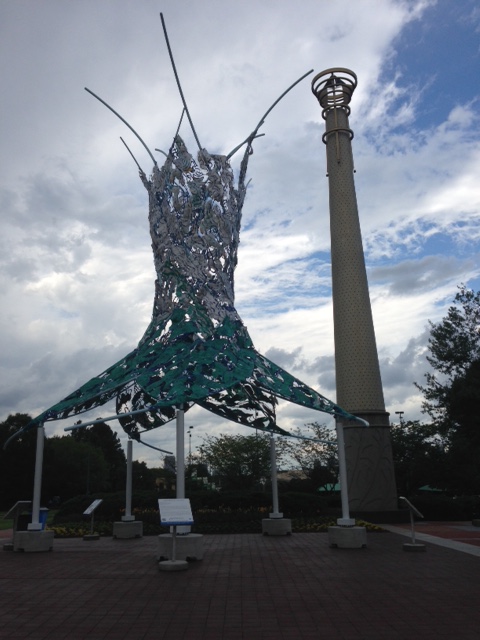
Embodied Energy Studio, Amandine Drouet, Dena Light, Mike Wsol
- Exit Strategy by Ike Holter, Directed by Kenny Leon
Reading done by True Colors Theatre. It was my first reading so I wasn't sure what to expect. Lots of laughter, lots of sudden intakes of breath as the story went from humorous to a serious critique or tragic event. I thought it was great with the actors lined up in a row reading from their scripts so I can't wait to see how a set adds or detracts from some of the more powerful moments, such as the suicide or the demolition of the school. I hope I get to see the fully produced play so I can compare.
Reading done by True Colors Theatre. It was my first reading so I wasn't sure what to expect. Lots of laughter, lots of sudden intakes of breath as the story went from humorous to a serious critique or tragic event. I thought it was great with the actors lined up in a row reading from their scripts so I can't wait to see how a set adds or detracts from some of the more powerful moments, such as the suicide or the demolition of the school. I hope I get to see the fully produced play so I can compare.
Looking forward to: Atlanta Fringe Festival this weekend and Playmaking for Girls next week
National Center for Civil & Human Rights: Giving Voice to the Voiceless? by Halley Freger


Going to this museum was a very emotional experience. The focus wasn’t on facts and dates, but challenging systems of oppression. I was very moved by the interactive exhibit that recreates the experience of a sit-in. I was thankful for the next part of the exhibit where I got to sit in a dark room, watch a video, and cry. I needed that time to be alone and reflect on the experience.
After the sit-in interactive experience I started thinking about why it affected me so strongly. I liked how it wasn’t about playing the role of someone at a sit-in, but showing me the level of fear they experienced. And by ending with a message about recognizing the heroic people of color who fought to end segregation, it focused on their strength. As I sat there, hearing people scream and feeling them push my chair, I truly understood the power required of people who participated in sit-ins.
I’m often frustrated when people try to recreate the experience of a group. For example, I remember being irritated in high school when my friends went to a church event where they didn’t eat for 24 hours in order to experience hunger. I knew of another group that went on a trip to help homeless people, and weren’t allowed to shower that week. I thought it was kind of ridiculous. How did this help anyone? How did it allow them to gain a better understanding of poverty? I don’t think it did. Because the difference is, at the end of the day or at the end of the week, they got to go to their houses where they had access to food and running water. I didn’t like the idea of playing the role of the impoverished. It was their choice to not eat or shower, but the people they were supposedly helping did not have a choice. Unlike these experiences, I think the sit-in exhibit, and all the exhibits at the Center for Civil & Human Rights, were beautifully done and really pushed me to think critically and feel deeply, without allowing me to play the part of a group I’m not a part of.
I began thinking a lot about the Youth Creates theme of “giving voice to the voiceless.” Coincidentally, this was the theme of the Martin Luther King, Jr. exhibit. I think the wording of this theme is odd, because it implies that oppressed people are incapable of speaking. The issue isn’t that women, people of color, people with disabilities, and other marginalized groups are incapable of speaking; the issue is that no one is listening. This theme also implies that someone is responsible for giving voice to a voiceless group. Why should someone who isn’t a member of the marginalized group speak for them? Do you have to be a member of a group to properly advocate for them? MLK called for people of color to have the “moral courage to stand up for their rights.” This doesn’t sound like he gave “voice to the voiceless,” but rather gave voice to the silenced. Oppressed people have a lot to say and a lot to fight for, the problem is how to you give them the time to speak, and how do you get people to listen?
Here are some quotes I collected at the museum that relate to the theme of people who are silenced:
“And I knew that I could never again raise my voice against the violence of the oppressed in the ghettos without having first spoken clearly to the great purveyor of violence in the world today: my own government.” –MLK
“The don’t know each other because they cannot communicate; they cannot communicate because they are separated.” –MLK

Tuesday, June 2, 2015
First Meeting by Celeste Miller
June 1 we had a first meeting with all the partners. Heidi from 7 Stages, Rachel from Synchronicity and Dana and Kaycee from Moving in the Spirit. A lot of information shared, a lot of information to process. One of the things that struck me was how differently everyone organizes their thinking and what they need as a way to mentally handle the conceptual frame of a project. Personally, I like a schedule or calendar first so that I can block out TIME. This allows me to know where I will be when, then I can fill in content. I know Rachel and I think similarly - this was evident when we did "Women + War". Heidi thinks in a nexus. All the pieces and their tangents, potentials, intersections. Kaycee was organized with handout materials (that didn't get distributed, hmmm I need to follow up on that), and I think that these were to give information to provide foundation for understanding, and were solid, something to have in hand. To hold. To feel solid. Dana, among other things, wants to assure that we are all transparent, communicating, respecting everyone in the circle - and making sure that we are acknowledging all voices even those not present at the table. I know these women so well, and I love that everyone works differently. In this particular context, I was able to sit back and feel like I could observe because my role is different. I am not a collaborator, I am a facilitator to bring the Grinnell team into the mix of these three organizations, who just happen to have some overlapping work together this summer.
To summarize: we each approach a project of this scope with a different inclination of how to start managing the conceptual idea. Will it be through schedule? Through the conceptual frame? Through something solid like written information on paper? Through making sure that the moral values and tenets are upheld? We will all get to the same place - but we need to get there differently. This was something Liz (Lerman) made us aware of as an organization. Trying to honor, not be frustrated by, everyone's difference. For me, I know that on X date at X time everyone will be in the room together and the work will begin. "Woyaya" Great song that I know from ROOTS. I can't find as upbeat a version the way Elise (Witt) leads it, but here goes: lyrics follow.
Lyrics by: Osibisa
To summarize: we each approach a project of this scope with a different inclination of how to start managing the conceptual idea. Will it be through schedule? Through the conceptual frame? Through something solid like written information on paper? Through making sure that the moral values and tenets are upheld? We will all get to the same place - but we need to get there differently. This was something Liz (Lerman) made us aware of as an organization. Trying to honor, not be frustrated by, everyone's difference. For me, I know that on X date at X time everyone will be in the room together and the work will begin. "Woyaya" Great song that I know from ROOTS. I can't find as upbeat a version the way Elise (Witt) leads it, but here goes: lyrics follow.
We are going, heaven knows where we are going,
but we know within.
and We will get there, heaven knows how we will get there,
but know we will.
yes We will get there, heaven knows how we will get there,
but know we will.
but we know within.
and We will get there, heaven knows how we will get there,
but know we will.
yes We will get there, heaven knows how we will get there,
but know we will.
It will be hard we know
And the road will be muddy and rough,
But we'll get there, heaven knows how we will get there,
but We know we will.
woyaya,woyaya,woyaya,woyaya,woyaya,woyaya,woyaya,woyaya
And the road will be muddy and rough,
But we'll get there, heaven knows how we will get there,
but We know we will.
woyaya,woyaya,woyaya,woyaya,woyaya,woyaya,woyaya,woyaya
We are going, heaven knows where we are going,
but we know within
and We will get there, heaven knows how we will get there,
but know we will.
but we know within
and We will get there, heaven knows how we will get there,
but know we will.
It will be hard we know
And the road will be muddy and rough,
But we'll get there, heaven knows how we will get there,
but We know we will.
woyaya,woyaya,woyaya,woyaya,woyaya,woyaya,woyaya,woyaya
woyayadiyaya, woyaya,woyayadiyaya,woyaya, woyaydiyaya,woyaya,woyayadiyaya.
And the road will be muddy and rough,
But we'll get there, heaven knows how we will get there,
but We know we will.
woyaya,woyaya,woyaya,woyaya,woyaya,woyaya,woyaya,woyaya
woyayadiyaya, woyaya,woyayadiyaya,woyaya, woyaydiyaya,woyaya,woyayadiyaya.
Lyrics by: Osibisa
Subscribe to:
Posts (Atom)